Please ensure Javascript is enabled for purposes of website accessibility

Unpacking CMS’ $50 Billion Investment into Rural Healthcare

As rural health funding rolls out, one big question emerges: Will this investment solve the challenges faced by remote and hybrid care in 2026? In this session, we unpack what this investment means for hospitals, communities, and technology adoption, and what leaders should be preparing for now.
Flying mail

Send this to my inbox

Send this to my inbox

Speakers
Dr.DaveNewman
Dr. Dave Newman
Chief Medical Officer for Virtual Care
Dr.WilliamWertheim
Dr. William Wertheim
Executive Vice President
Jason Mitchell
Jason Mitchell
Chief Medical Officer
Joe Brennan
Joe Brennan
VP
Christina Farr
Christina Farr
Editor-in-chief/CEO
Key learnings:
  • $50B is meaningful, but only if it’s deployed with long-term sustainability in mind. The previous cuts (which add up to far more than $50B) must also be taken into account.
  • Rural access challenges extend far beyond geography, including workforce shortages and fragile care infrastructure.
  • Virtual care and hybrid models are essential, not optional, for rural health transformation.
  • Flexibility in how funds are used will determine whether innovation actually reaches patients.
  • Technology must support clinical workflows, not create new administrative burden.

Funding alone won’t fix rural care

CMS’ $50 billion investment represents one of the most ambitious commitments to rural healthcare in recent memory, but panelists were clear that funding on its own is not a silver bullet. Rural health systems are navigating a complex mix of reimbursement pressure, rising operating costs, workforce shortages, and shrinking margins. In that context, new funding can easily be consumed by keeping the lights on rather than driving real change. 

Speakers emphasized the importance of being deliberate about where and how dollars are deployed. Investments that prioritize short-term stabilization without addressing underlying care delivery challenges risk leaving rural communities in the same position once funding sunsets. The consensus: this moment requires strategic decisions that build durable models designed to improve access, efficiency, and clinical sustainability well beyond the life of the program.

So on the one hand, fifty billion seems like a lot of money. But as we’ll discuss in this webinar, there were also one trillion dollars in cuts. So fifty versus a trillion — you guys can do the maths.

Christina Farr

Editor-in-chief/CEO

Rural health challenges are structural, not just geographic 

The conversation pushed back on the idea that rural health is simply an access-by-distance problem. While geography plays a role, panelists underscored that many of the most significant barriers are structural: limited clinician availability, overextended staff, outdated infrastructure, and care models that weren’t designed for low-density populations. 

Rural providers are often expected to deliver the same breadth of services as large systems with fewer resources and thinner margins. Addressing these challenges means rethinking how care is organized and supported, not just expanding physical footprints. Speakers highlighted the need for models that strengthen local care teams, reduce unnecessary patient transfers, and make specialty expertise available without requiring patients to leave their communities.

This isn’t just about geography. It’s really about whether you have the workforce, the infrastructure, and the ability to support clinicians who are trying to take care of very complex patients with very limited resources.

Dr. Dave Newman

Chief Medical Officer for Virtual Care

Virtual and hybrid care are foundational to scale

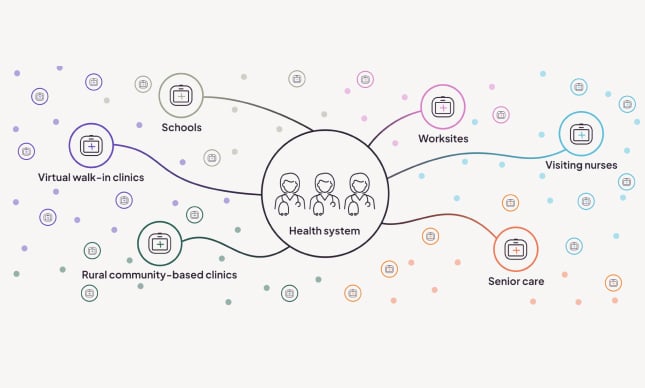
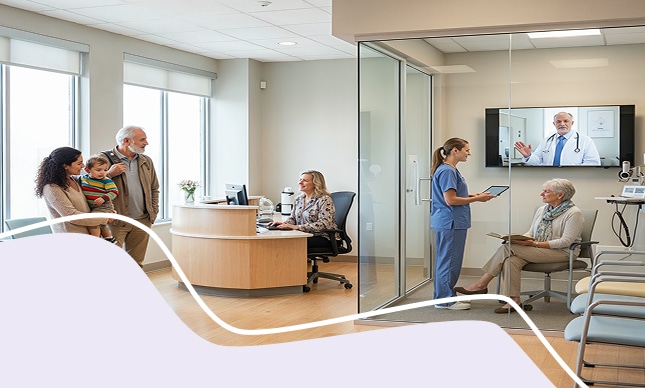
Virtual care emerged as a core strategy for translating investment into impact. Rather than being framed as a temporary workaround, hybrid care models were positioned as essential infrastructure for rural health systems looking to scale access responsibly. When virtual tools are embedded into clinical workflows, they can extend the reach of scarce specialists, support frontline clinicians, and enable more care to happen closer to home. 

Panelists stressed that success depends on integration, not layering new technology on top of already strained processes. Thoughtfully designed virtual care programs can reduce clinician burden, improve continuity, and make rural care models more resilient. As funding flows into the system, the message was clear: virtual and hybrid care are not optional add-ons but are foundational to making rural healthcare sustainable.

If we’re going to make rural healthcare work long term, you can’t think of virtual care as a nice-to-have. It has to be built into how care is delivered every single day, especially in places where there just aren’t enough providers.

Joe Brennan

VP