Digital Tools, Real Results: What the Data Says About Telehealth in Schools

School-based telehealth has officially moved from “nice idea” to measurable impact.
In the 2022-23 school year, 28% of students were chronically absent, meaning they missed at least 10% of the school year (about 18 days). That’s not a small operational headache. It’s a learning crisis.
Now layer on another reality: many schools are trying to solve growing student health needs without enough clinical coverage. CDC analysis based on national school data found that only 45% of U.S. public schools had a full-time on-site nurse, while 25% had no school nurse at all.
This is where telehealth in schools earns its place. Not as a replacement for school nurses, and not as a shiny technology layer. It works when it’s designed as a support system that helps nurses do what they already do, with faster access to medical evaluation and stronger clinical backup.
And importantly, the case for school telehealth is no longer based on vibes. We have real data.
The Attendance Equation: Health Access Keeps Students in Class
There’s a persistent myth that attendance is an “education issue” and health is a separate lane. In practice, they’re tightly linked. The American Academy of Pediatrics points out that students with poor attendance score lower than peers on national assessments, and that regular attendance can be a strong predictor of school success and graduation outcomes.
If you care about educational outcomes, you have to care about the in-school health pipeline that keeps kids in class.
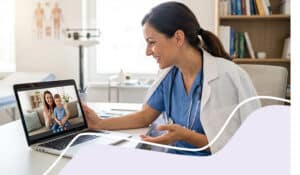
School-based telemedicine is one of the few interventions that can affect the “send home vs. stay in school” decision in real time.
A Regional Educational Laboratory (REL) West study looking at school-based telemedicine visits found that nearly all visits resulted in students returning to class for the remainder of the day, with students receiving an average of about 3 hours of instructional time after the visit.
That is the core operational value. Not simply “telehealth is convenient.” It’s that care is delivered without automatically triggering a half-day absence.
Shifting Utilization Away From High-Cost Settings
The impact extends beyond attendance. Data from school-based virtual care programs shows significant avoidance of unnecessary emergency department and urgent care visits. In one partnership, 27 percent of parents reported they would have gone to the ER if school-based telehealth had not been available. Another 45 percent would have sought care at an urgent care clinic. Instead, children were evaluated at school.
For health systems, this matters. Redirecting non-urgent cases away from high-cost settings supports better resource allocation, improves continuity with primary care, and reduces avoidable spending.
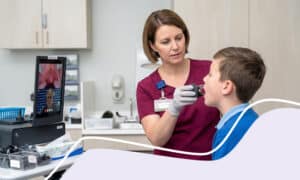
Remote physical exams play a key role here. When school staff can conduct guided exams using connected diagnostic tools, providers gain clinical visibility. That visibility builds confidence. And confidence reduces defensive referrals.
The result is smarter site-of-care decisions and better care navigation.
Supporting, Not Replacing, School Nurses
It bears repeating: virtual care in schools is not designed to replace nurses. The best models do the opposite. They position the nurse as the clinical anchor inside the building, then use telehealth to expand what’s possible.
That approach aligns with the National Association of School Nurses (NASN), which states that telehealth is a valuable tool that can assist registered professional school nurses in enhancing access to school and community health services.
In strong models, nurses and telepresenters work together. Nurses remain the trusted clinical leaders within the school environment. Virtual providers serve as an extension of their expertise, available when additional evaluation is needed. This partnership model strengthens school health programs. It gives nurses more tools, more support, and more options for their students. It does not diminish their role. It elevates it.
Equity in Action: Meeting Families Where They Are
For many families, schools are the most consistent point of contact with the healthcare system. Transportation barriers, limited primary care access, parental work constraints, and insurance challenges all contribute to delayed care. When health services are embedded into the school day, those barriers shrink.
This is especially important in rural communities and underserved urban districts. Virtual care in schools ensures that geography does not dictate access. And when families know their child can receive care without leaving campus, it reduces disruption. Parents avoid unplanned time off work. Students avoid unnecessary absences. Providers strengthen relationships within the community. School-based telehealth becomes part of a broader access strategy, not a standalone technology initiative.
A Model Built on Partnership: Cone Health’s Approach
Cone Health offers a clear example of what intentional design looks like.
Through its Whole School, Whole Community, Whole Child model, Cone Health partnered directly with school district leadership from the start. The program established shared metrics, including attendance, early dismissals, academic indicators, and behavioral outcomes.
Formal agreements defined roles, responsibilities, and compliance standards, including HIPAA and FERPA considerations. Clinical pathways were developed collaboratively. Internal stakeholders, from school nurses to behavioral health teams, were engaged early.
This level of alignment matters. Successful programs are not plug-and-play. They are co-designed with districts, measured, accountable, and built to support the professionals already serving students every day.
What the Most Effective Programs Have in Common
Across health systems that have implemented school-based telehealth, several patterns emerge:
- Executive alignment between the health system and district leadership
- Clear clinical protocols and defined escalation pathways
- Measurable outcome tracking, especially around attendance and utilization
- Strong nurse engagement and partnership
- Sustainability planning from the outset
The technology enables the program. But partnership sustains it.
The Results Are Clear. The Opportunity Is Growing.
School-based telehealth has matured. The conversation has shifted from “Can this work?” to “How do we scale responsibly?” The data shows improvements in attendance. It shows reduced unnecessary utilization. It shows expanded access in communities that need it most. And critically, it shows that when virtual care is implemented as a partnership model, it strengthens school health programs rather than replacing them.
For providers looking to expand access, improve community health, and address chronic absenteeism, schools represent one of the most strategic environments in healthcare today.
To explore real-world case studies and hear directly from health system leaders building these programs, watch the full School Health Virtual Summit 2026.
When digital tools are thoughtfully integrated into existing care models, the results are not theoretical. They are measurable.


Latest Blogs